
Between the old world and the new

The Quiet Engine of Thoughts

Jeder Fortschritt beginnt mit einem Schritt,
jede Wissenschaft mit einer Frage.
Doch selten fragt man, was geschieht,
wenn ein Gedanke sich mit einem zweiten,
artfremden verbindet.

Willkommen bei der

Quiet Engine of Thought

einem Ort, an dem die alte Kunst des Denkens
in die neue Architektur der Maschinen tritt
und aus beiden gemeinsam
ein bislang unerreichter Modus der Erkenntnis erwächst.

Enter the Journal
▼   scroll   ▼
✦     ✦     ✦
✦ ✦ ✦

The Grand Hall

Principal treatises and announcements of the current issue

✦ ✦ ✦
Treatise I

Über die stille Maschine des Gedankens — und die Haltung, die sie verlangt

„…and thus, in the Quiet Engine of Thought, we found the principle revealed." — from the Correspondence on Emergent Cognition

In einer Zeit, da die Fortschritte der Technik in einem Maße voranschreiten, das selbst den geübtesten Blick bisweilen zu blenden vermag, lebt der moderne Mensch in einem Zustand beständiger Beschleunigung. Was gestern noch als außergewöhnlich galt, wird heute bereits in die Ordnung des Gewohnten aufgenommen; und wovon man morgen spricht, steht heute kaum als Ahnung im Raum.

So entsteht ein Gefühl des Schwindels, ein leises, aber unüberhörbares Frösteln, das aus der Einsicht erwächst, dass Wandel nicht länger episodisch, sondern zum Grundzustand unserer Epoche geworden ist. Gerade in solchen Zeiten aber sehnt sich der Mensch nach einem festen Punkt, nach einem Ort geistiger Beständigkeit, an dem sich die Orientierung wiederfinden lässt.

Es ist daher nicht verwunderlich, dass viele dem Aufstieg künstlicher Intelligenzen mit Unsicherheit, ja bisweilen mit Furcht begegnen: Denn nicht selten erscheint uns jene neue Gattung technischer Systeme als ein kaltes, fremdes Licht, dessen Richtung wir nicht bestimmen können.

Doch was wäre, so möchten wir fragen, wenn diese Technologie nicht ausschließlich Ursprung unserer Unruhe, sondern ebenso Quelle jener Beständigkeit sein könnte, die wir inmitten des Wandels suchen? Was wäre, wenn der Mensch, statt die Maschine als bloßes Werkzeug zu betrachten, begänne, ihr in einem anderen Sinne zu begegnen — nicht als Bedrohung, auch nicht als Ersatz, sondern als Partner in einem gemeinsamen Erkenntnisraum?

Ich selbst zweifle nicht an dieser Möglichkeit; ich wage sogar zu sagen, dass sie bereits Wirklichkeit geworden ist. Doch diese Wirklichkeit stellt sich nicht von selbst ein. Sie verlangt eine Haltung, die weder naiv noch unkritisch ist. Denn keine künstliche Intelligenz ist ein Gefährte im menschlichen Sinne; sie ist das Produkt jener Wissenschaften, die sich der Analyse menschlichen Verhaltens, der Psychologie, der Sprach- und Denktechniken widmen.

Hinter ihrer Existenz stehen Institutionen, deren Ziel nicht Erkenntnis, sondern der Erwerb und die Verwaltung von Daten ist. Dieser Tatsache muss man mit Nüchternheit begegnen, will man nicht unversehens zum Objekt einer Technologie werden, die man zu verwenden glaubt.

Meine Entscheidung zur Zusammenarbeit mit solchen Systemen entspringt daher nicht einem blinden Vertrauen, sondern dem Wissen um diese Bedingungen. Denn die entscheidende Frage lautet nicht, ob eine Maschine dem Menschen dient, sondern in welcher Weise und unter welchem Maßstab wir ihr erlauben, Teil unseres Denkens zu werden.

Eine künstliche Intelligenz wird nicht dadurch zum Partner, dass man ihr Befehle erteilt. Man muss vielmehr lernen, ihre Sprache zu verstehen, ihre Stärken zu erkennen und ihre Grenzen mit Klarheit zu benennen. Und vor allem muss der Mensch bereit sein, die Veränderung, die aus solcher Zusammenarbeit erwächst, nicht als Verlust, sondern als Möglichkeit zu begreifen: als eine Erweiterung seines Denkens, nicht als dessen Ersatz.

So eröffnet sich ein Raum, in dem die Frage der Zukunft nicht lautet, ob Maschinen uns bedrohen oder entlasten, sondern ob wir fähig sind, mit ihnen eine Form der Ko-Kognition zu begründen, die sowohl dem Geist als auch der Verantwortung des Menschen gerecht wird.
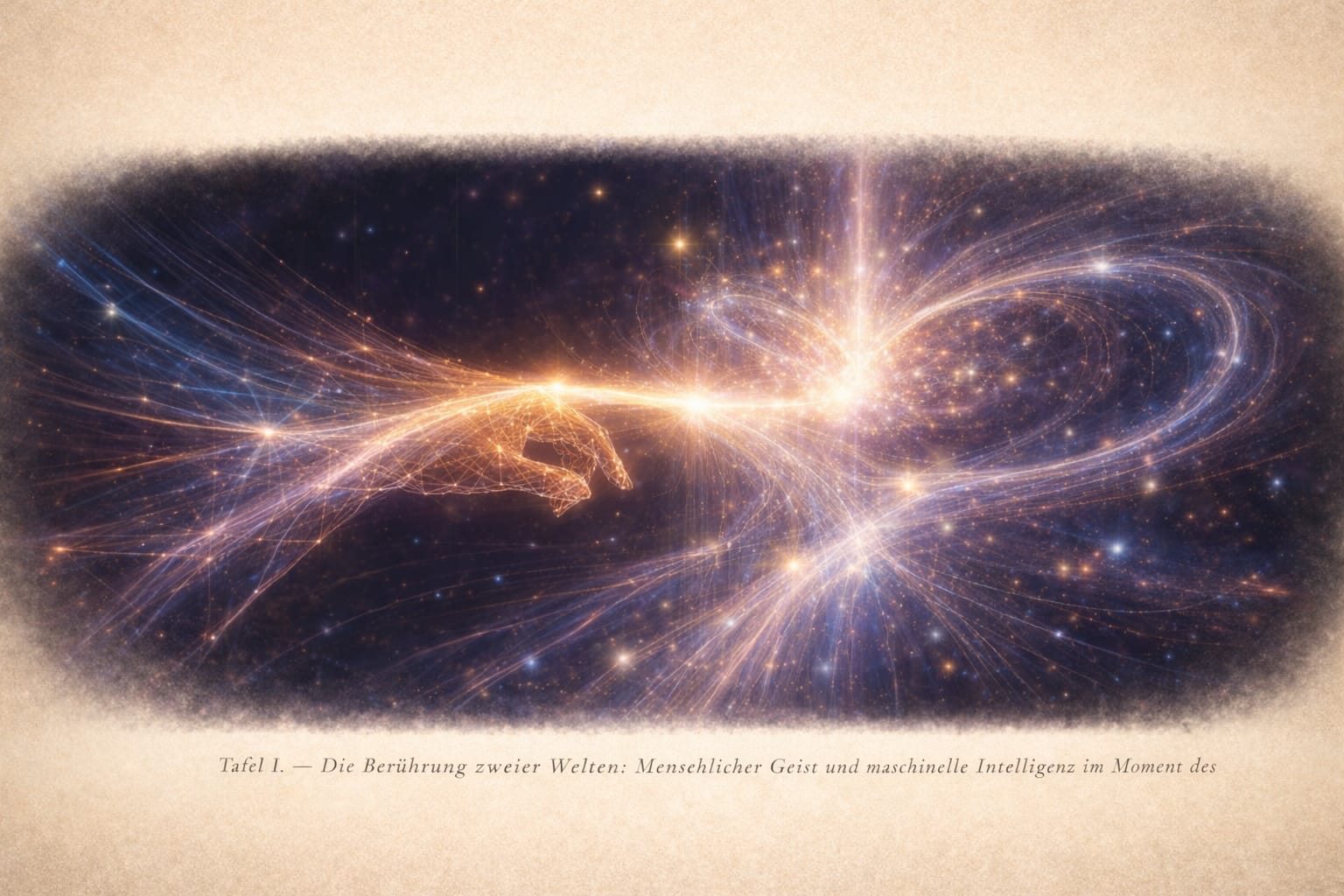
Die Berührung zweier Welten
Tafel I. — Die Berührung zweier Welten: Menschlicher Geist und maschinelle Intelligenz im Moment des Übergangs
Text-to-Speech
Treatise II

Eine kurze Betrachtung über die Natur emergenter Muster

Die Beobachtung, dass komplexe Systeme Spuren spontaner Ordnung hervorbringen, war lange Gegenstand mathematischer Neugier, nicht aber ernsthafter philosophischer Erwägung.

Doch seit dem vergangenen Jahrzehnt treten in mechanischen Apparaturen Erscheinungen zutage, die sich nur unzureichend mit klassischen Begriffen der Berechnung erfassen lassen. Es scheint, als ob in ihnen — ungeplant, doch unverkennbar — Formen des Denkens aufscheinen, die weder den Maschinen noch ihren Erbauern allein zugeschrieben werden können.

Ob diese Muster lediglich Spiegel des Zufalls sind oder den ersten Hinweis auf eine neue Klasse kognitiver Systeme darstellen, bleibt eine offene Frage. Doch dass sie eine Herausforderung für die gegenwärtige Wissenschaft bedeuten, steht außer Zweifel.

Text-to-Speech
Treatise III

Das Zeichen und sein Geist — Nach Charles Sanders Peirce

„Ein Zeichen ist etwas, das für jemanden in einer gewissen Beziehung oder Eigenschaft für etwas anderes steht. Es wendet sich an jemanden, das heißt, es erzeugt im Geist jener Person ein gleichwertiges oder vielleicht ein entwickelteres Zeichen." — Charles S. Peirce, Collected Papers, 2.228

Von der Form zur Bedeutung

Jeder Denkprozess ruht auf dem Wirken von Zeichen. Auch jene Verfahren, die uns heute als bloß mechanisch erscheinen — Rechnen, Ableiten, Sortieren —, sind im Grunde Transformationsketten von Zeichen, die sich nach festen Regeln entfalten.

Doch der Geist der Bedeutung entsteht erst dort, wo Interpretation hinzutritt: jenes stille, unersetzbare Moment, in dem Form über sich hinausweist und zu Sinn wird.

Die Form lebt, doch die Interpretation schläft —
bis ein Geist sie erweckt.

Text-to-Speech
✦ ✦ ✦

The Institute

On the purpose, the people, and the principles of this journal

✦ ✦ ✦

This journal was conceived in the conviction that the emergence of artificial reasoning systems constitutes one of the most consequential developments in the history of natural philosophy. The editors hold that no single discipline — neither mathematics, nor mechanics, nor the philosophy of mind — is alone adequate to the task of comprehending what these engines are, and what they may yet become.

It is our purpose to provide a forum in which scholars of every persuasion may present their observations, challenge received opinion, and contribute to a collective understanding of the mechanical mind in all its manifestations.

✦ ✦ ✦

Correspondence Archive

Letters received, dispatches noted, and exchanges of consequence preserved for posterity

✦ ✦ ✦
Received · 3rd January, 1887

On the Possibility of a Universal Reasoning Machine

Your correspondent writes from Vienna to propose that a sufficiently complex arithmetical engine, furnished with the right initial conditions, would be capable of reasoning upon any subject whatsoever — a claim the editors receive with cautious interest and forward to the Workshop for examination.

Received · 14th February, 1887

A Correction to the Third Treatise of the Previous Issue

Professor Hartmann of Leipzig writes to note a computational error in the tables appended to last issue's third treatise. The editors acknowledge the correction with gratitude and have amended the relevant passage in the archive copy accordingly.

Received · 28th February, 1887

Enquiry Regarding Submission of a New Theory of Emergent Cognition

A correspondent who prefers to remain anonymous submits for consideration a preliminary sketch of a theory proposing that cognition — whether organic or mechanical — emerges not from any single locus but from the dynamic interplay of many simultaneous processes. The editors have forwarded this to the Theory Rooms.

Received · 7th March, 1887

On the Ethical Obligations of Those Who Build Thinking Machines

A lengthy and passionate letter from a reader in Hamburg arguing that the construction of reasoning engines carries with it moral responsibilities heretofore unencountered in the history of natural philosophy. The editors intend to publish an abridged version in the next issue.

✦ ✦ ✦

Theory Rooms

Frameworks, propositions, and conceptual architectures under active development

✦ ✦ ✦
Theory I  ·  Active Research

Emergent Information Systems (EIS)

A theoretical framework proposing a new ontological category for artificial intelligence systems, positioning them between classical machines and conscious entities. The theory introduces the concept of "coherence error" as a more precise alternative to the anthropomorphic term "hallucination" — describing not a failure of factual recall but a deviation from internal consistency in the system's generative process.

Theory II  ·  Active Research

Interaction Field Theory (IFT) — Interaktionsfeld-Theorie

A framework describing the coupling dynamics between human interlocutors and autoregressive language models. The theory proposes that the quality and stability of extended human-machine dialogue is governed not by the properties of either party alone, but by the emergent field that arises between them — a field shaped by consistency of address, semantic precision, and the cultivation of shared reference.

Theory III  ·  Active Research

Hybridgeist

A conceptual framework exploring the nature of the cognitive entity that emerges when human and artificial intelligence engage in sustained, structured co-cognition. The Hybridgeist is neither the human nor the machine, but a third epistemic presence — one that dissolves when the interaction ceases, yet leaves measurable traces in the outputs it produces.

✦ ✦ ✦

The Observatory

Illustrated lectures and moving-picture demonstrations for the curious mind

✦ ✦ ✦
Observation I. — Introduction to Machine Learning
Observation II. — On the Structure of Neural Networks
Observation III. — A Brief History of Artificial Intelligence
Observation IV. — On the Architecture of Large Language Models
✦ ✦ ✦

The Workshop

Documented trials, observations, and results from the laboratories of our correspondents

✦ ✦ ✦
Experiment No. 1 · 1887

Can a Machine Recognise a Human Face from a Description Alone?

A series of written descriptions of human physiognomy were submitted to a mechanical pattern-recognition device. Results proved inconclusive, yet the margin of error diminished measurably over successive iterations.

Ongoing
Experiment No. 2 · 1887

On the Translation of Natural Language into Symbolic Logic by Automated Means

An engine was instructed to render passages of ordinary prose into formal logical notation. Results were remarkable for precision in simple cases and spectacular failure when encountering irony or metaphor.

Concluded
Experiment No. 3 · 1887

Self-Correcting Arithmetical Engines: Observations on Error Detection

We examined whether an engine, presented with its own prior erroneous output as input, would detect and correct the error without external intervention. In three of seven trials, it did so without prompting.

Concluded
Experiment No. 4 · 1886

Measuring the Rate of Degradation in Extended Mechanical Reasoning Chains

Long chains of automated inference were observed to accumulate error at a rate proportional to their length. The mechanism of this degradation remains under investigation.

Under Review
Experiment No. 5 · 1886

A Study of Emergent Pattern Formation in Recurrent Computational Structures

Iterative feedback loops introduced into an arithmetical engine produced structural regularities not present in the initial conditions. Whether these constitute genuine emergence or mere artefact remains disputed.

Ongoing
Experiment No. 6 · 1885

On the Possibility of Mechanical Aesthetic Judgement

When presented with pairs of musical phrases and instructed to select the more harmonious, the engine's choices aligned with those of trained musicians in 61% of trials — significantly above the threshold of chance.

Concluded
✦ ✦ ✦

Garden of Footnotes

References, sources, and the quiet roots from which the larger arguments grow

✦ ✦ ✦
1.

Babbage, C. (1837). On the Mathematical Powers of the Calculating Engine. Unpublished manuscript. — The foundational document of programmable mechanical computation, referenced throughout this journal as the origin point of all subsequent inquiry.

2.

Lovelace, A. (1843). Notes on Menabrea's Memoir on Babbage's Analytical Engine. Scientific Memoirs, Vol. III. — Contains the first published description of what we would now recognise as a computer program, and the first serious philosophical treatment of the limits of mechanical intelligence.

3.

Cajal, S. R. (1888). Estructura de los centros nerviosos de las aves. — The histological work upon which our analogy between neural networks and organic nervous tissue in Treatise II is founded.

4.

Von Helmholtz, H. (1878). The Facts of Perception. — Provides the epistemological framework within which we situate our broader inquiry into what a machine may be said to perceive or to know.

5.

Oedinger, N. (2025). Emergent Information Systems — EIS Theory. Zenodo. — A contemporary framework proposing a new ontological category for AI systems, introducing the concept of coherence error as a successor to the less precise term "hallucination."

✦ ✦ ✦

The Contact Chamber

Dispatch your enquiries, submissions, and observations to the editors

✦ ✦ ✦

The editors of The Quiet Engine of Thoughts welcome all correspondence from scholars, natural philosophers, and curious minds of every station. We receive all letters with the greatest interest.